
How decision making actually works
What happens when players make decisions, and why the language of coaching matters, but not in the way you might think.

When I was growing up, I remember hearing a comparison made between Australian and English batters. English batters, it was said - conforming to the traditionally conservative stereotypes - would look to defend first, and then attack if it was a bad ball. Australians, meanwhile - brash and in-your-face and aggressive - did the reverse. They’d start from the point of trying to hit the ball for 4. As the ball travelled and an Aussie batter became aware this wasn’t possible, he or she might ‘bail out’ and look to defend instead. It was a concept that played on (now outdated) stereotypes of how the teams played, starting at opposite ends of the aggression spectrum by default and working their way inwards when forced.
That stereotype makes some assumptions about how decision making actually works in cricket. I’m talking about reaction-based, instinctive decision making here - the kind of decisions batters have to make when facing a 140+kph bowler. We’ll save the more ‘conscious’ decisions for another time. Even the phrase ‘decision making’ may almost seem a bit weird for a skill that is essentially subconscious, because batters don’t have time to consider the pros and cons of playing a particular shot as the ball travels towards them. Instead, when we coach ‘decision making’, the time constraints mean we settle for some pre-ball cues (like looking for a 4 first or looking to defend first) and hope that instincts do the rest. And those cues have big implications for how the batter might play.
Let’s get in-depth with batting. When you’re batting in cricket, and the bowler lets go of the ball, you have a very important initial decision: do I play it off the front foot, stepping towards it and catching it low enough to the ground? Or do I need to move backwards, giving myself height to ride the bounce? The movements aren’t the same - going forward means pushing your head towards the ball, going back creates height but still leaves your head the ‘forward’ side of your body.
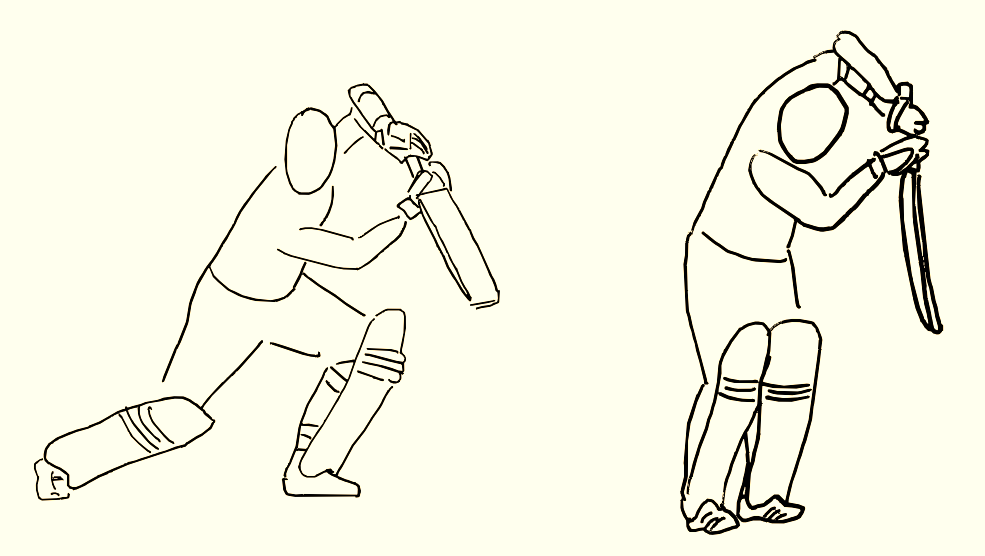
At any rate, you might think the best thing to do would be to start without any pre-conceived ideas, to give you the best chance of making the right decision. But that’s usually not what happens. Most of the best players in the world try to anticipate going forward, even if the ball isn’t going to be full. Why? Because if you go forward, and it’s full, you are - obviously - in the perfect position to play it. But if you look to go forward, and it’s a short ball, having your weight shifted as if going forward is still helpful - you can be quicker to push off with your front foot, and your head remains the ‘forward’ side of your body, in a good position to play the ball once you’ve moved.
The reverse doesn’t work - thinking of going back means your weight goes backwards, and leaning back is no good for moving forwards. Weirdly it’s no good for going backwards either, because you end up with your head the wrong side of your body, in no position to play the shot. The thing to do if you want to play both types of ball well, therefore, is to expect it full.
Essentially, a skill like batting is asymmetrical. The mental cue or instruction that helps batters get into the best position for the ball isn’t always the most accurate (the ball could be full or short), it’s the one that unlocks the best process (set up to play a full ball). As an algorithm, ‘assume A, if not A then B’ is often better than ‘wait to see if it’s A or B’.
For another example of the best cue not being the most accurate one, take a look at interviews with rugby players returning from injury. They mention that the injury can play on your mind when you go into a collision, and this makes things worse. Thinking ‘don’t get injured’ makes you more likely to get injured, because you hesitate, don’t commit, and end up in a worse position. Committing to the collision, on the other hand, gives you the best of both worlds: you’re more likely to win it, and you’re more likely to get into a position which reduces the risk of injury.
So, cueing a batter to move forward helps them get into good positions, and make good decisions as a result, whether they end up moving forward or not. Often, batters’ cues are slightly different from just ‘move forward’ though. Because there are other cues which not only supply them with the intent to move forward, but also tee them up to move quickly, get their hands into a better place to time the ball, and more. And those cues are often about looking to score, looking to attack, or being positive. It’s important for players and coaches to work to come up with a cue which works best for them. In short: you don’t need to be thinking about all the options available to you in order to make all those options available to you. You’re better off using a more precise cue which tees you up for the best option, and allowing your body to react naturally if it needs to adapt.
Let’s go back to the original stereotype of Australian batters looking to hit the ball for 4 as a default, and English batters looking to defend. This description was an insult to the English batters - it didn’t just reflect a culture difference, it reflected a difference in performance on the pitch. English batters were timid, slow-scoring, and simply didn’t play as well as their Australian opponents. Perhaps there was some truth to the stereotype, and perhaps there’s a reason why most modern batters prefer defaulting to an aggressive option.
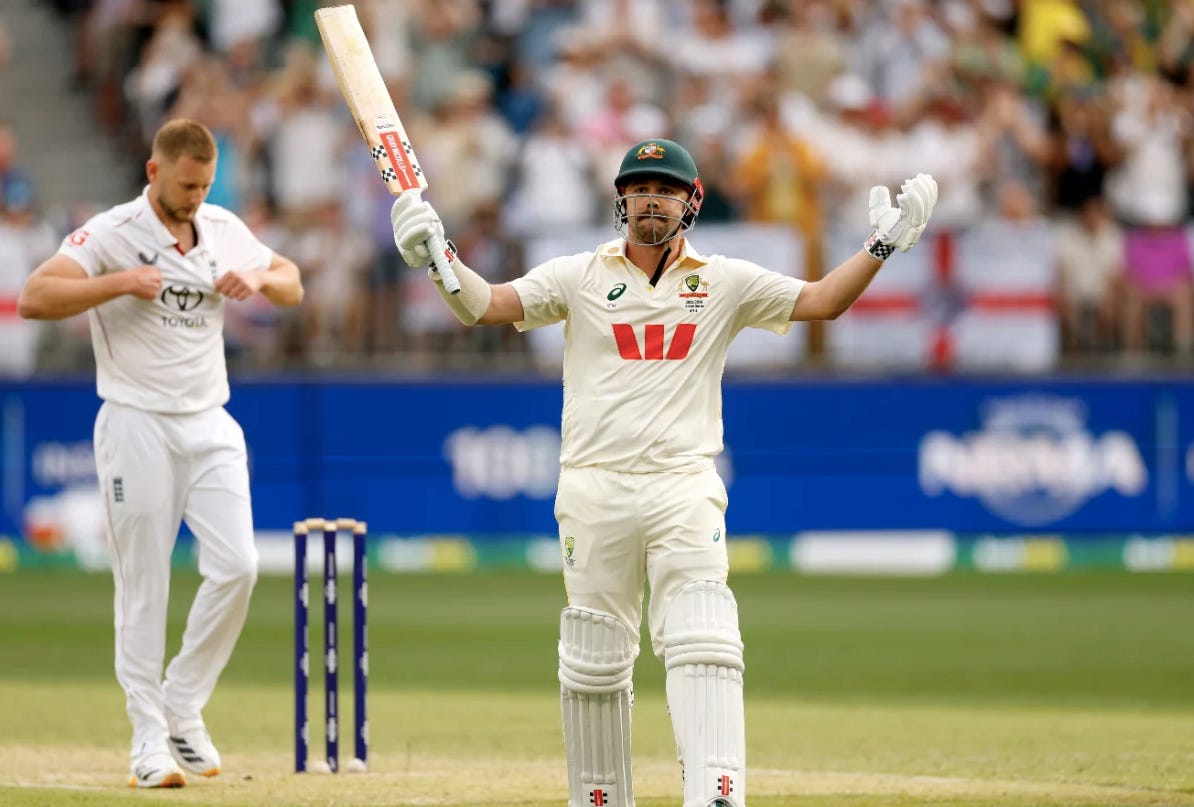
When England played Australia in the first Ashes test, aggressive options were in full view. Travis Head’s second innings 123 off 83 balls blazed the way for Australia in the run chase; it followed a first innings where Australia largely went nowhere because they lacked any intent to score. England tried to be aggressive too, but didn’t succeed. Where Travis Head was precise with which aggressive options were the best risk/reward value, England took low percentage ones. On a bouncy pitch, Head flashed with a cross bat while England pushed away from their bodies with a vertical one. England collapsed and left the door open for Head to barge through.
The lesson? Aggression still allows for precision; sustainable aggression probably requires it. And precise cues are fine, because as we’ve just seen, cues don’t need to describe your whole game to be effective.
Love seeing how your mind works man. Great, insightful write up.